University of Deusto
Important information: the platform is currently in a pilot phase to evaluate its effectiveness as an educational tool on the impact of climate change on human health in mountain regions.
The MOUNTADAPT training programme is part of the wider MOUNTADAPT project, a Horizon Europe initiative dedicated to strengthening the resilience of health systems in mountain regions facing the growing impacts of climate change. Discover more in the link below:
The course content is organized into seven modules described below.
Understand the drivers of climate change and their impacts on human health; assess associated health risks; and apply effective adaptation and mitigation strategies within healthcare settings.
Individuals working in the health sector, including researchers. 
7,6 hours
Understand the interconnections between human health, anthropogenic environmental change, and social and ecological determinants of health, including how climate change interacts with other environmental pressures, and identify relevant solutions within healthcare contexts.
Individuals working in the health sector, including researchers. 
8 hours
Develop effective climate and health communication skills by tailoring messages to diverse audiences, recognizing key communication challenges, using reliable information sources, and applying lessons from local and regional climate-related threats and disasters.
Healthcare Professionals (including physicians, nurses, allied health professionals, and healthcare assistants); Health Policy-Makers, Planners and Public Health Officials. 
5,6 hours
Understand the health impacts of climate change on disease patterns and analyse trends in changing distributions and prevalence from local to global levels, in order to inform effective clinical and public health responses.
Healthcare Professionals (including physicians, nurses, allied health professionals, and healthcare assistants); Health Policy-Makers, Planners and Public Health Officials. 
7,5 hours
Develop and implement practical strategies to reduce the carbon footprint of healthcare delivery across settings by applying green healthcare principles and using relevant tools, toolkits, and guidelines to support mitigation and adaptation measures.
Healthcare Administrators, Managers and Support Staff; Health Policy-Makers, Planners and Public Health Officials. 
8 hours
Understand and apply disaster medicine principles to assess health system risks and vulnerabilities, evaluate preparedness, and manage patient care during extreme weather events, with particular attention to mountain contexts and the social and psychological dimensions of disasters.
Healthcare Professionals (including physicians, nurses, allied health professionals, and healthcare assistants). 
7,5 hours
Understand the scope and limitations of technological and digital solutions for addressing the health impacts of climate change, and plan their effective implementation in specific local contexts.
Individuals working in the health sector, including researchers. 
This module has no units.
2,5 hours
*All modules are open to any individual working in the health sector. The indications above are provided only as guidance.
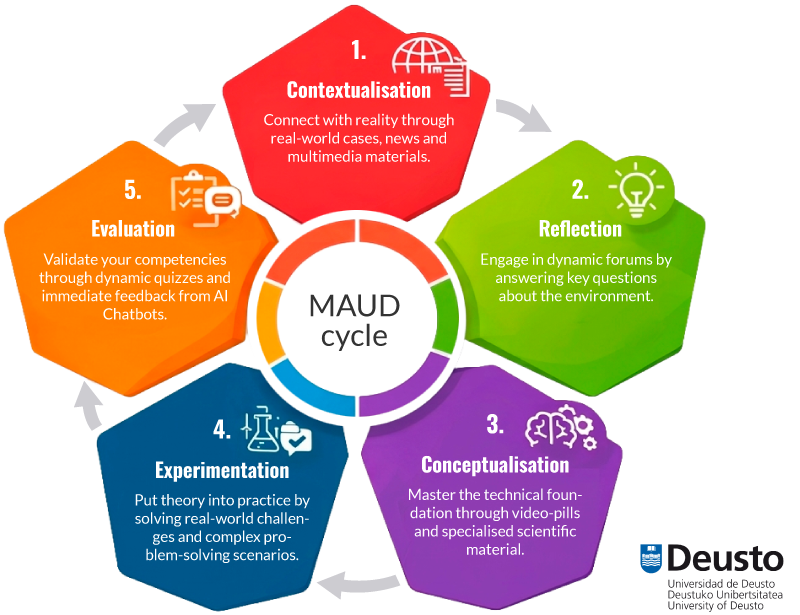
Each module is structured into five sections, each with a specific objective. This five-section structure follows the MAUD learning model, which is supported by the University of Deusto. This model represents the pedagogical strategy of the University of Deusto to facilitate the acquisition of new knowledge.